West Africa's New Trafficking Referral System Stops at Ghana's Northern Border
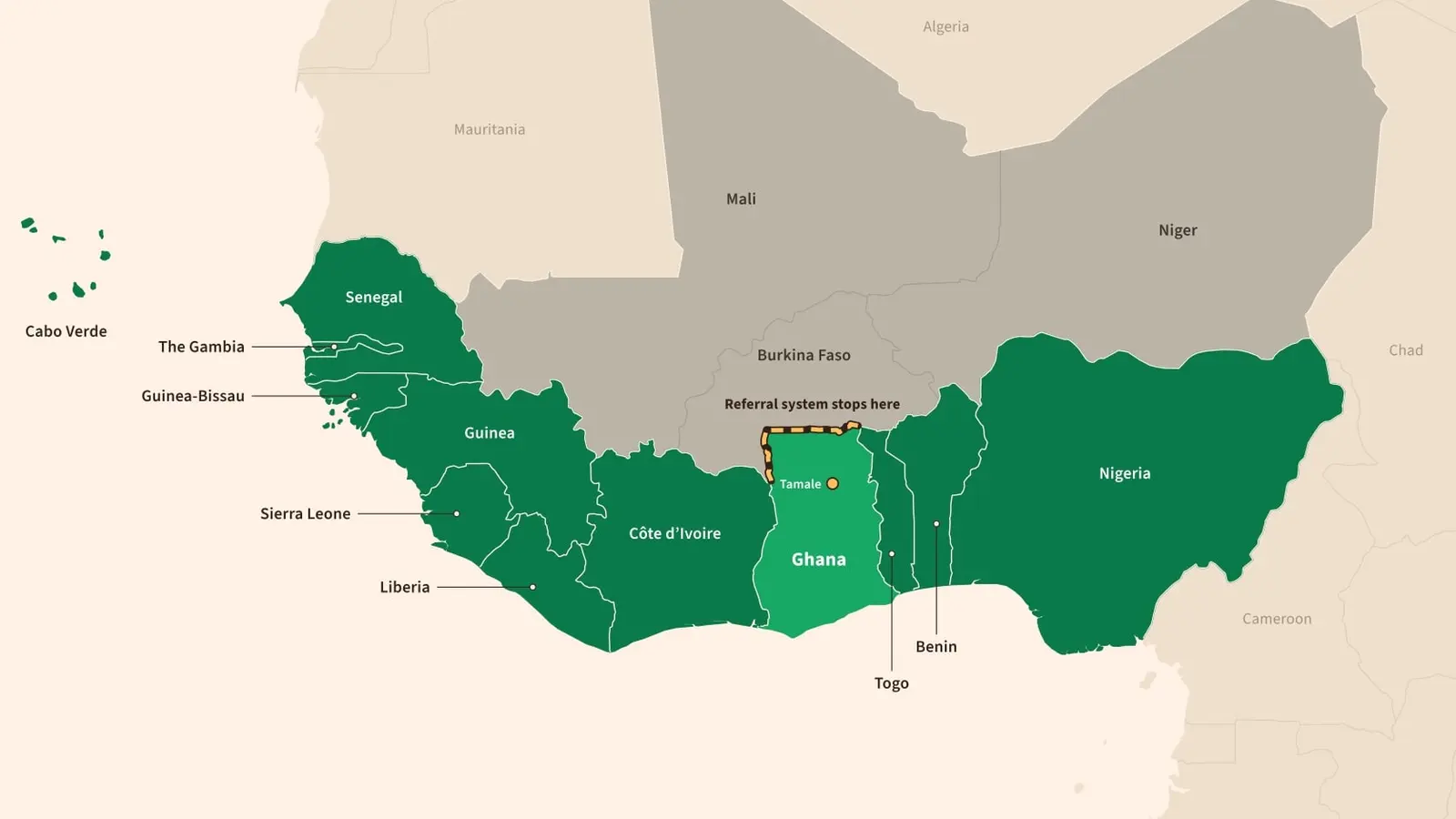
ECOWAS, its member states and their international partners met in Lagos last week to strengthen how West African countries identify trafficking victims and pass them to each other for protection. A new Regional Referral Mechanism is at the centre of that work, and Ghana is part of it. Burkina Faso, which borders Northern Ghana, is not. It left ECOWAS in January 2025, along with Mali and Niger.
In brief
- What met: the 18th Annual Review Meeting of the ECOWAS Regional Network of National Focal Institutions Against Trafficking in Persons, in Lagos from 16 November 2026 (The Guardian Nigeria).
- What is new: RRM West Africa, an EU-funded project worth EUR 3.2 million, run by ICMPD with ECOWAS from January 2026 to December 2028, to put the Regional Referral Mechanism into practice (ICMPD factsheet).
- Who it covers: Benin, Cabo Verde, Côte d’Ivoire, The Gambia, Ghana, Guinea, Guinea-Bissau, Liberia, Nigeria, Senegal, Sierra Leone and Togo.
- Who it does not: Burkina Faso, Mali and Niger, now the Alliance of Sahel States (AES).
What the meeting said
The speakers agreed on one point. Binta Adamu Bello, Director-General of Nigeria’s National Agency for the Prohibition of Trafficking in Persons (NAPTIP), said no country can tackle trafficking on its own while criminal networks work across borders. Ivanka Hainzl of the International Centre for Migration Policy Development (ICMPD) went further. She said traffickers exploit the gaps between institutions and adapt as circumstances change, and that regional frameworks need practical systems behind them so that institutions can share information and coordinate help for victims.
Bello welcomed the new referral project as a step towards better identification, referral, protection and reintegration of victims across borders. The International Labour Organization pointed to the links between trafficking, forced labour and child labour, which fall hardest on women, children, migrants and people in informal work.
None of this is new. The network has met every year since 2007. What is new is money and a three-year plan to turn the referral mechanism from an agreed idea into working procedures.
What a referral mechanism does
When police, immigration officers or a social worker identify a trafficking victim from another country, a lot has to happen quickly. The person needs shelter, health care and legal help. Someone has to check whether it is safe for them to go home. Officials in the home country have to receive them, and someone has to support them once they are back, so that the same recruiter does not find them again. Investigators on both sides need to share evidence if anyone is going to be prosecuted.
A national referral mechanism sets out who does what inside one country. Ghana has one. The 2026 Trafficking in Persons Report says the government has standard operating procedures to identify victims and refer them to services, coordinated by the Human Trafficking Secretariat under the Ministry of Gender, Children and Social Protection. A regional mechanism links these national systems, so that a case started in Accra can be handed to officials in Lomé or Abidjan using procedures both sides have already agreed.
This matters because Ghana’s trafficking is increasingly cross-border. Of the 2,331 victims Ghana identified in 2025, the report says 1,469 were foreign nationals, from Nigeria, Côte d’Ivoire, Burkina Faso, Cameroon, Togo, Senegal, Niger and Benin. The government also paid for 567 Ghanaians exploited abroad to come home. The report adds that cross-border and transnational networks now exploit adults for forced labour and online scams more often than networks operating only inside Ghana.
Where the map ends
The twelve countries in the new project are the twelve countries that remain in ECOWAS. Burkina Faso, Mali and Niger formally left on 29 January 2025 and formed the Alliance of Sahel States. That leaves the Regional Referral Mechanism stopping at the border between Ghana’s Upper East and Upper West regions and Burkina Faso.
For HEP, that border is not a line on a map. We have written about the Burkina Faso-Ghana-Côte d’Ivoire triborder area, which the Global Initiative Against Transnational Organized Crime classes as a high-risk illicit hub with Tamale on its routes. We have written about the 17 transhumance corridors IOM has mapped running from Burkina Faso into the Upper West. Northern Ghana’s borders with Togo and Burkina Faso are long and porous, and people, livestock and goods cross them every day.
The 2026 Trafficking in Persons Report for Burkina Faso shows how much moves along this route. Traffickers take Burkinabe children to Côte d’Ivoire, Mali, Senegal and Niger for forced labour in artisanal gold mining, begging and cocoa production, and for sexual exploitation. Côte d’Ivoire, a destination on that list, is inside the new mechanism. Burkina Faso, where the children come from, is not.
Cooperation has not stopped
It would be wrong to say Ghana and Burkina Faso no longer work together. The same report records that in June 2025 Burkina Faso, with a foreign government’s help, repatriated 20 Burkinabe trafficking victims from Ghana, and that its authorities worked with Ghana on a trafficking investigation linked to QNET. Burkina Faso was upgraded to Tier 2 this year. It identified 369 victims in 2025 and referred all of them to care, up from none reported the year before, and it has its own identification and referral procedures.
These are real gains. The difference is that each case now depends on the goodwill of two governments and on a foreign partner willing to help, not on procedures, funding and training shared across the region. The report is frank about Burkina Faso’s capacity: shelter for adult victims is severely limited outside the capital, and the government allocated 13 million FCFA (about $23,000) for victim services in a year.
Ghana has its own pressures. The report notes that the government shelter for adult women was not working during the reporting period. A 2023 study of Ghana’s cooperation and referral mechanisms by Ampah and Kandilige found that differing definitions, a lack of money and equipment, and weak collaboration between partners held them back, while recognising that coordination had improved significantly under the Human Trafficking Secretariat. Those weaknesses are hardest to work around in exactly the cases that cross into a country outside the shared system.
What would help
Put trafficking into the ECOWAS-AES framework. In October, ministers from both blocs met in Dakar and agreed to build a framework for cooperation that would largely preserve visa-free movement and trade (MyJoyOnline). If people can still cross the border freely, victims crossing it need protection too. A short annex on referring trafficking victims, based on the procedures the RRM project is already developing, would help close that gap.
Write the Ghana-Burkina Faso route into Ghana’s next action plan. Ghana’s National Plan of Action against trafficking runs from 2022 to 2026, so a new one is due. It should include a written, published protocol with Burkina Faso covering who receives a victim at the border, who checks it is safe for them to return, and who supports them afterwards.
Watch the 2025 Annual Synthesis Report. The Lagos meeting reviewed it but it has not been published. If ECOWAS releases it, we will look at what it says about cross-border cases involving Ghana and track them in the West Africa Trafficking Monitor. We raised the same question about the Nigeria-Mali route in the Monitor briefing of 18 November.
Prevention comes first
A referral system starts working only after someone has been trafficked. It is essential, and it is the last line, not the first. The best point to act is before a recruiter’s offer is accepted, in the communities the cross-border routes start from.
That is where HEP works. Our SMART Schools Program teaches young people in Northern Ghana to recognise how trafficking recruitment works, to make safer decisions and to tell a trusted adult early. Better referral across West Africa will help the people it reaches. Prevention in schools near the border means fewer young people need it. For more on what protects children in Ghana, read our guide to child trafficking in Ghana and our analysis of Ghana’s Tier 1 upgrade.
Questions and answers
What is the ECOWAS Regional Referral Mechanism?
It is an agreed set of procedures for ECOWAS member states to identify victims of cross-border trafficking and pass them between countries for protection, return and reintegration. The RRM West Africa project (EU-funded, EUR 3.2 million, 2026 to 2028, run by ICMPD with ECOWAS) is putting it into practice in 12 countries, including Ghana.
Is Burkina Faso still in ECOWAS?
No. Burkina Faso, Mali and Niger left ECOWAS on 29 January 2025 and formed the Alliance of Sahel States. In October 2026 ministers from both blocs agreed in Dakar to build a cooperation framework, but trafficking was not among the areas reported.
How does Ghana refer trafficking victims to services?
Ghana has standard operating procedures for identifying victims and referring them to services, coordinated by the Human Trafficking Secretariat under the Ministry of Gender, Children and Social Protection. The government runs four shelters and can refer victims to 12 accredited NGO shelters, according to the 2026 Trafficking in Persons Report.
Do Ghana and Burkina Faso still cooperate on trafficking cases?
Yes, case by case. In June 2025 Burkina Faso repatriated 20 Burkinabe trafficking victims from Ghana with a foreign government’s support, and the two countries worked together on a trafficking investigation linked to QNET. That cooperation is bilateral, outside the regional referral system.
Stay in touch
Join our mailing list
Occasional updates on our work in Northern Ghana, straight to your inbox.