The Weaponization of Hope: Fighting Trafficking for Armed Conflict with Education
When we discuss human trafficking, we often visualize forced labor in factories or sexual exploitation in city centers. However, a terrifying new trend has emerged that demands our immediate attention: trafficking for armed conflict. As a recent investigation by The Guardian reveals, unsuspecting African men are being tricked into fighting on the frontlines of Russia’s war in Ukraine. This grim reality underscores why the preventative education we deliver at the Hope Education Project (HEP) is more vital than ever.
The “Bait and Switch”: Anatomy of Fake Foreign Job Scams
The Guardian’s report highlights the harrowing story of “Stephen Oduor” (a pseudonym), a 24-year-old Kenyan man who simply wanted a livelihood. After months of unemployment, Oduor fell victim to fake foreign job scams promising him work as a plumber in Russia with a monthly salary of KSh100,000 ($770 USD)
The setup appeared professional: agents handled travel arrangements, and Oduor paid a placement fee believing he was securing his future. But upon arrival in St. Petersburg, the deception unraveled. He was driven to a safe house, his luggage was confiscated, and he was taken to a police station where he was coerced into signing documents written entirely in Russian—a language he did not understand.
It was only when he was transported to a military facility that the truth became undeniable: he had not been hired as a plumber. He had been trafficked. “I didn’t know how to shoot anything,” Oduor recalled, yet he was deployed to the Ukrainian border, handed an assault rifle, and ordered to shoot down weaponized drones from foxholes.
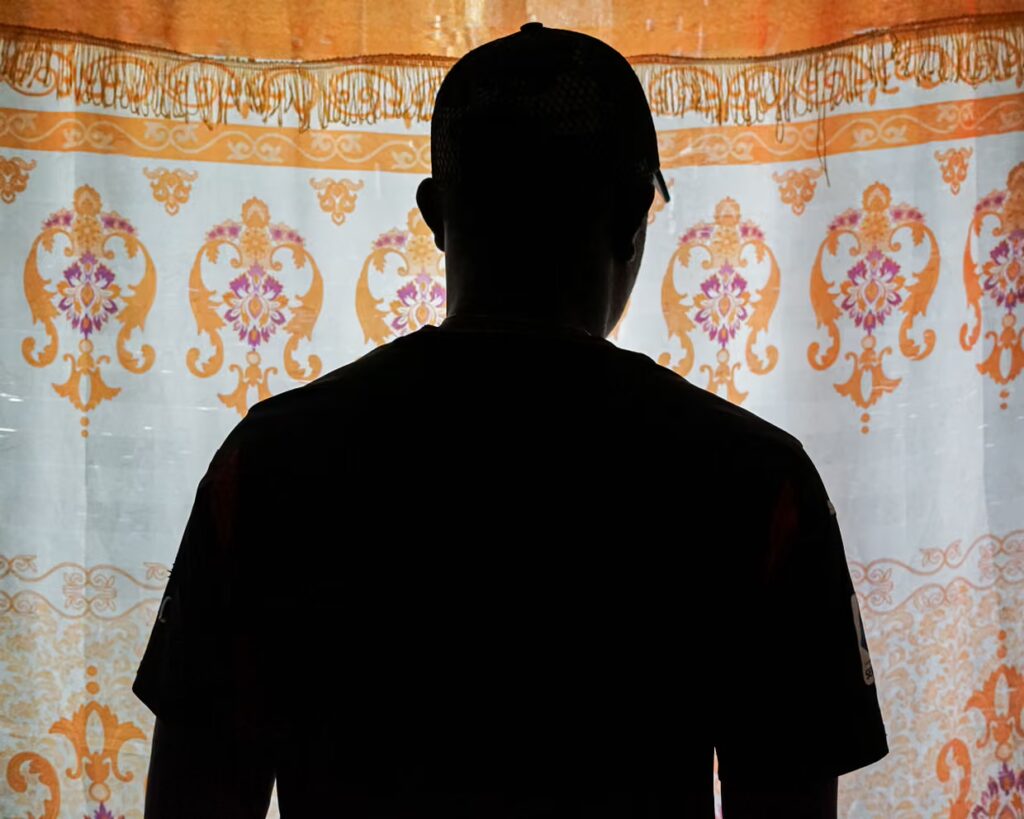
One Kenyan man who was trafficked to fight for Russia in its war with Ukraine but managed to escape has shared his story under a pseudonym. Photograph: Carlos Mureithi © The Guardian
“Disposables”: Africans Fighting in Ukraine
This form of trafficking for armed conflict relies on the total dehumanization of its victims. Reports suggest that Africans fighting in Ukraine under these schemes are often viewed as “disposables” by their commanders. Disturbing footage purports to show African men being used as human “beacons”—ordered at gunpoint to walk ahead of assault groups to draw enemy fire or detonate landmines so Russian troops can advance safely behind them.
For families back home, the silence is agonizing. Susan Kuloba, a mother from Kenya, was told her son David had secured a job as a security guard. Instead, he was conscripted. His last communication was a voice note before a mission: “If I’ll have died, take the documents to the embassy… they’ll give you a pay cheque.” She has not heard from him since and fears he was killed in action.
Digital Safety Against Trafficking: How HEP Protects the Vulnerable
The tragedy of Stephen, David, and hundreds of others serves as a devastating proof of concept for our work. These traffickers succeeded because their victims lacked specific knowledge regarding recruitment standards, contract rights, and digital safety against trafficking.
At the Hope Education Project, our mission is to disrupt this flow of exploitation. Here is how our curriculum acts as a protective shield:
1. Spotting the Trap Online – (Module 3) Recruitment networks are capitalizing on digital platforms to post fraudulent adverts. In our schools program, [Module 3: Online Safety, Online Trafficking & Reporting] teaches young people how to navigate this digital minefield. We teach students to scrutinize the source of online advertisements and identify offers that are “too good to be true.” If Stephen had been equipped with these skills, the initial online offer might have raised a red flag before he ever left Kenya.
2. The Power of “No” and Understanding Contracts – A critical moment in the trafficking process occurred when the victims were forced to sign documents in Russian. HEP’s Module 2: Traffickers, Victims & Staying Safe focuses on the methods traffickers use to deceive and coerce. Our core slogan—”Be smart! Be strong! Say NO when things feel wrong!”—is a survival instruction. We teach young people that they have the right to refuse to sign documents they cannot read, creating a mental barrier against coercion.
3. Community-Led Awareness – Traffickers thrive on isolation. The agents in Kenya leveraged local employment agencies to appear legitimate. This is why our work extends to community programs for women & out-of-school girls. By educating mothers, sisters, and community leaders, we create a safety net. When families are informed, they are better equipped to question the validity of a “security guard” job in a conflict zone.
Fighting Desperation with Knowledge
As we expand our work in Northern Ghana, supported by our Survivor Advocate, Wunzooya, we use lived experience to challenge the norms that facilitate exploitation. Whether the destination is a brothel in Dubai or a trench in Ukraine, the tactics of trafficking for armed conflict remain rooted in deception.
By teaching young people to recognize these tactics and demand transparency, we are building a generation that is harder to trick and harder to traffic. We want our youth to seek opportunity, but we are dedicated to ensuring they do not pay for it with their lives.
You can read the original reporting by The Guardian here.