Human trafficking in Ghana scored 7 out of 10 on the 2023 Organised Crime Index and has remained on the US State Department’s Tier 2 watchlist since 2017. Between 2019 and 2023, the number of identified victims increased by 107%, from 701 to 1,451 cases annually. Those figures reflect improved detection as much as they reflect the scale of the problem – identification systems remain weak, rural reporting is inconsistent, and a significant proportion of victims never recognise what happened to them as trafficking at all. The true scale is considerably larger than what official data captures.
Ghana as Source, Transit and Destination
Ghana sits at the intersection of three distinct trafficking dynamics. Children from the north are trafficked south to work in Lake Volta’s fishing communities, on cocoa farms in the Western Region, and in domestic servitude in Accra and Kumasi. Women are trafficked through Ghana toward Côte d’Ivoire and beyond. Citizens from Nigeria, Burkina Faso, and Côte d’Ivoire are simultaneously trafficked into Ghana for forced labour and sexual exploitation. Understanding the country as all three – source, transit, and destination – matters because the interventions required are different at each point.
Labour trafficking accounts for 61% of reported cases nationally, with sexual exploitation making up the remaining 39%. Children are the majority of identified victims. In 2022, 776 girl victims were recorded compared to 675 boys – a gendered pattern that reflects the types of exploitation each faces, not a difference in underlying vulnerability.
Why Northern Ghana Is the Primary Source Region
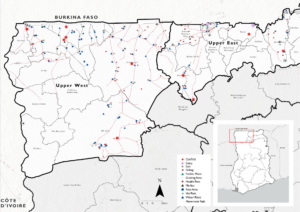
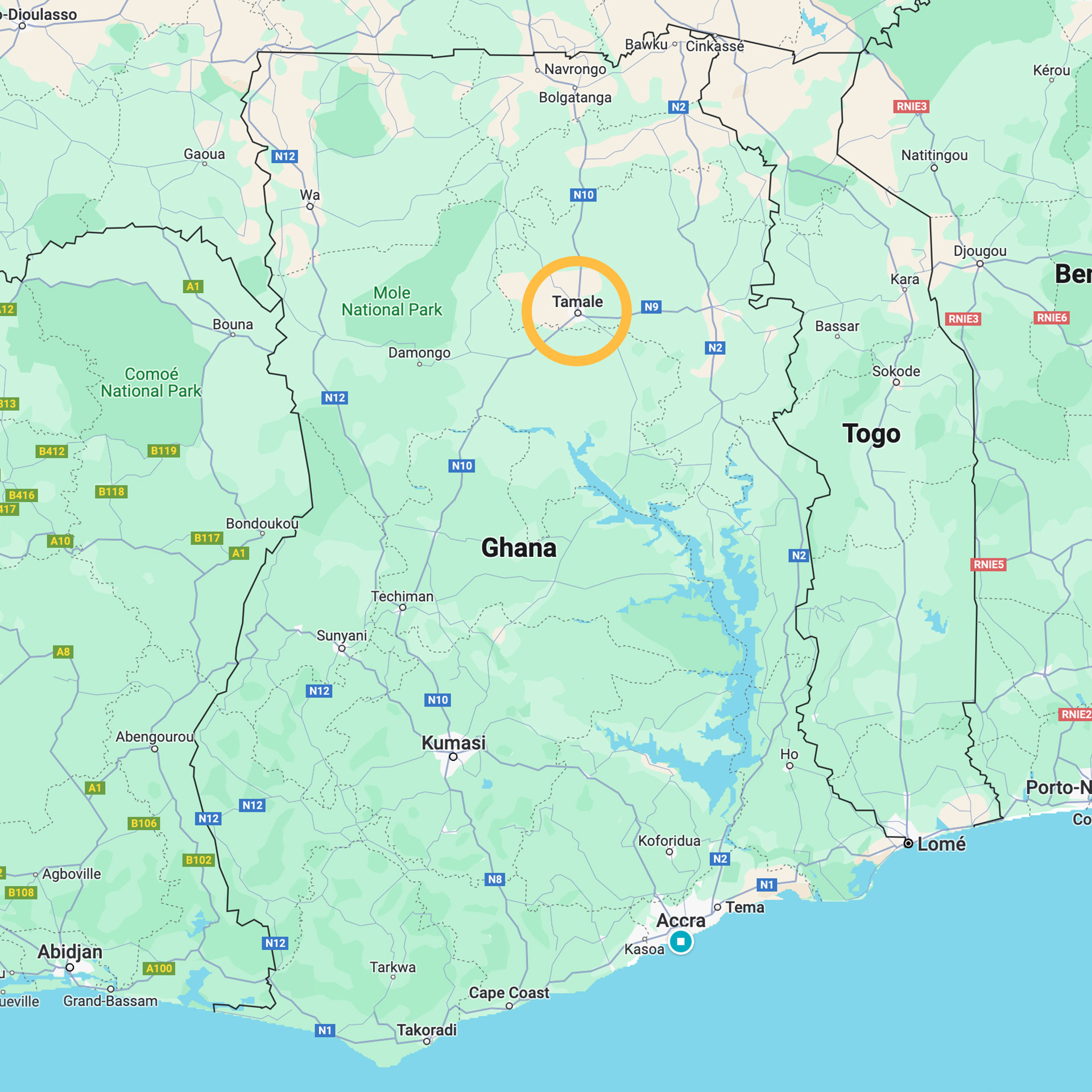 Approximately 90% of Ghana’s internal trafficking flows from north to south, and that concentration is not coincidental. It is the direct consequence of a development gap with colonial roots. Infrastructure investment under colonial administration was concentrated in the south – ports, factories, institutions, and economic opportunity built in Accra, Tema, Kumasi, and Takoradi, with the northern regions left deliberately peripheral. Successive governments have not meaningfully closed that gap. The Northern, North East, and Upper regions consequently carry the country’s highest poverty rates, lowest educational attainment, and fewest formal employment opportunities.
For young people in communities like Tamale, Walewale, Dushegu, and Dimla, this creates a structural situation where taking a risk on an offer from outside the community is not irrational – it is one of the only routes to something different. Research conducted across these communities found that six out of ten young participants said they would accept an offer from a stranger if it came with a phone or the promise of a better future. One girl explained it with striking clarity: “Our parents would be happy with the support, and they might even push us to go.” That is not naivety. It is a calculation made under conditions of severe economic constraint, and it is the condition that recruiters are specifically designed to exploit.
How Recruitment Actually Works
The recruitment patterns operating in northern Ghana are well-documented and follow recognisable scripts, which is precisely why education around them is effective.
The most prevalent route for internal labour trafficking runs through the cultural practice of child placement – a longstanding tradition of sending children to live with relatives or acquaintances in urban areas for the purposes of schooling or work. The tradition itself is legitimate and deeply embedded in Ghanaian family life. Traffickers exploit it by operating through trusted networks: a family friend, a community figure, someone who has returned from Accra with visible success. The deception is rarely dramatic. An out-of-school girl from Tamale described the experience directly: “Yes, I lived with my aunt while I was in school, but every day she said she didn’t have money for my books or food, so I had to stop attending school.” What begins as a placement opportunity ends in exploitation, often without any single moment the family or child could clearly identify as the point of harm.
 For the Gulf state corridor, the primary mechanism is the fake job offer. Ghanaian women are recruited for domestic work in Bahrain, Kuwait, Oman, Qatar, Saudi Arabia, and the United Arab Emirates. Despite a government ban on labour migration to Gulf states, the Attorney General reported persistent increases in 2025, with traffickers now routing victims through Nigeria and Togo to circumvent scrutiny at Kotoka Airport. Victims typically pay GHS 10,000 to 15,000 in upfront placement fees – money borrowed, money that creates debt bondage before the journey even begins.
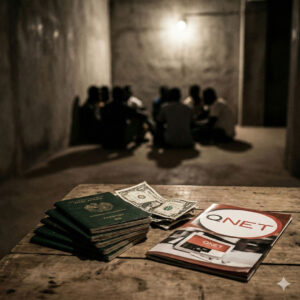
Digital recruitment has fundamentally changed the scale and speed of these patterns. Facebook and TikTok are now primary recruitment channels, allowing traffickers to reach young people in rural northern communities without ever appearing in person. In January 2026, Ghanaian police rescued over 100 young people aged 20 to 35 from two locations in Ho, Volta Region, having been lured through social media with fake offers including football contracts and foreign university placements. Many had paid GHS 10,000 to 15,000 to QNET-linked operations without informing their families. That detail is not incidental – isolation from family is how control is established, and it begins before the victim has left home.
What the Law Says and Where It Fails
Ghana’s Human Trafficking Act (Act 694, 2005, amended 2009) criminalises all forms of trafficking with a minimum sentence of five years, rising to 25 years for organised criminal networks. The 2015 Human Trafficking Prohibition Regulations added further enforcement mechanisms, including prohibitions on document confiscation and mandatory victim support requirements.
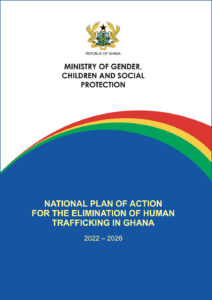 The government’s current National Plan of Action for the Elimination of Human Trafficking in Ghana 2022-2026 structures the official response around four pillars: Prevention, Protection, Prosecution, and Partnership. The 2026 plan builds on its predecessor and represents genuine institutional architecture – a coordinated framework across the Ministry of Gender, Children and Social Protection, the Human Trafficking Secretariat, the AHTU, EOCO, and civil society partners. The Human Trafficking Management Board, reconstituted in August 2025 under Minister Dr Agnes Naa Momo Lartey, is responsible for overseeing implementation. The plan exists. The question, as always, is enforcement at the level where it matters – in fishing communities on Lake Volta, at Kotoka Airport, and in the recruitment corridors of northern Ghana.
Enforcement is improving, but the gap between legislative intent and operational reality remains significant. In 2024, the Anti-Human Trafficking Unit, EOCO, and Ghana Immigration Service together initiated 273 investigations, prosecuted 65 individuals, and secured 25 convictions with sentences ranging from two to twenty years. Between 2023 and 2024 combined, 382 cases were investigated and 54 convictions secured. EOCO secured a notable prosecution in July 2025, convicting Nigerian national Precious Gold Okafor for trafficking a woman from Nigeria to Ghana’s Western Region for sexual exploitation. These are real gains.
The persistent and serious failure lies in fraudulent labour recruitment. Despite well-documented, widespread exploitation of Ghanaian workers abroad through fake employment offers, the government has not reported a single investigation or prosecution of a fraudulent labour recruiter in recent reporting periods. That gap – between a functioning anti-trafficking law and its complete non-application to the recruitment mechanism most commonly used against Ghanaian women – is where the majority of international victims fall.
Official complicity compounds the problem. Traffickers bribe law enforcement officers. Senior police have reportedly intimidated civil society organisations from reporting cases. Government-appointed monitors on fishing vessels have been bribed to file false reports on vessel conditions and crew welfare. The Human Trafficking Management Board was reconstituted in August 2025 with renewed commitment. Commitment on paper is necessary, but it is not sufficient without accountability in practice.
Gender Shapes Vulnerability in Distinct Ways
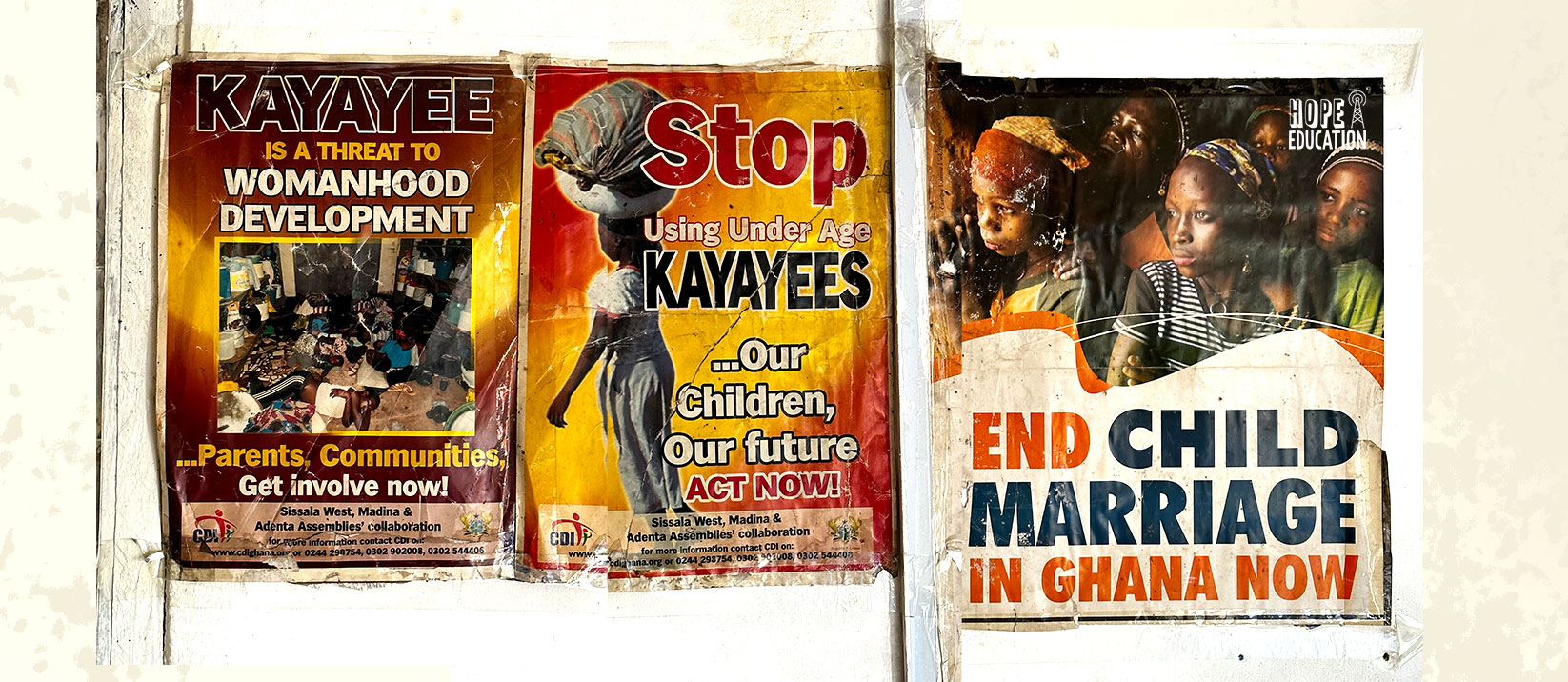
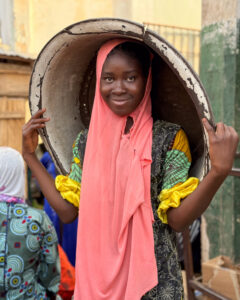 Girls in northern Ghana face a specific and well-documented set of risks. Domestic work and kayaye – head portering in urban markets – are the primary routes through which girls leave northern communities. Both create conditions for exploitation: debt to recruiters, accommodation insecurity, isolation from family networks, and sustained pressure to engage in transactional sex. As one participant in Dushegu described: “Most girls who leave end up as kayaye. Some of them are raped or forced into ashawo.” Early and forced marriage functions simultaneously as a recruitment mechanism and as a disposal mechanism – families under financial pressure directing daughters into arrangements that are, in practice, servitude.
Community attitudes toward victims frequently compound the harm. One participant observed: “Some people think that if a girl is involved in prostitution, it is her own fault, even if she was forced into it.” That framing – which places culpability on the victim rather than the recruiter, the buyer, or the structural conditions – is one of the mechanisms through which trafficking sustains itself in plain sight.
Boys face distinct but equally serious risks: forced labour in fishing and farming communities, recruitment into illegal artisanal mining, physical danger, and systematic non-payment for work performed. A boy from Walewale described it directly: “Boys go to the lake regions to fish for days without pay.”
Trafficking Prevention in Northern Ghana: What Works
Prosecution addresses trafficking after exploitation has occurred. It protects the next potential victim only if the trafficker is removed from operation and if that potential victim has the knowledge to recognise and resist the next approach – neither of which enforcement alone reliably delivers.
Education operates at the point before recruitment happens. A young woman who can recognise the structure of a fake job offer, who understands that her consent becomes legally irrelevant once exploitation begins, who has heard directly from a survivor about the reality behind promises of domestic work in the Gulf – she is meaningfully harder to recruit. Not impossible, because poverty, family pressure, and structural inequality remain. But harder. And harder, at scale, matters.
The evidence from northern Ghana communities makes this specific. Research conducted in Tamale, Dushegu, Dimla, and Walewale consistently showed that young people who remained in school had significantly lower direct exposure to trafficking situations than their out-of-school peers. When asked what protects children from traffickers, young people across every focus group gave the same answer: education. Not police. Not government hotlines. Not awareness campaigns. Education – and behind it, maternal support from mothers who pushed children to stay in school against the pressure of relatives, recruiters, and economic necessity.
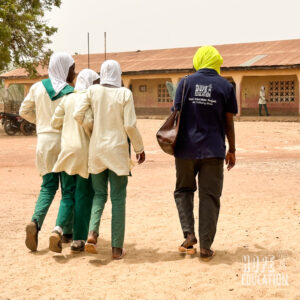
Hope Education Project works in Tamale and surrounding communities because that is where vulnerability is highest and educational infrastructure is weakest. The programme delivers anti-trafficking education in schools and directly to out-of-school girls – the group that field research and national data consistently identify as carrying the greatest risk. It is survivor-led because survivors are the only people who can describe with unimpeachable authority the distance between what trafficking promises and what it delivers, and that authority is what changes minds where statistics alone do not.
The Scale of the Challenge
Ghana has a functioning legal framework, improving prosecution rates, and genuine institutional commitment to addressing trafficking. None of that infrastructure currently reaches the girl in Dushegu being told she is going to Accra for work, the boy from Walewale being offered wages on the lake that will never be paid, or the young woman in Tamale receiving a Facebook message about a domestic work opportunity in Dubai. The distance between policy and lived reality in northern Ghana is significant, and it is filled – where it is filled at all – by community knowledge, by survivors willing to speak publicly, and by education that gives young people the tools to recognise exploitation before it begins.